Thursday, December 15, 2011

My ride in the NOAA P3 Hurricane Hunter


If you ask me what the main piece of the DYNAMO project is, I would say the 4 main ISS sites, including Diego Garcia, Male and two ships, the Revelle and the Mirai. There are some other land sites that are contributing data as well as the usual satellites. There is also a couple planes that have been flying in the vicinity of the DYNAMO array to help collect data over the open ocean. The one that has been working out of Diego Garcia is a P3 owned by NOAA that is usually based in Tampa to investigate hurricanes in the Atlantic.

The team of crew and scientists extended us an invitation to ride on the plane several times, but there were a couple reasons why this didn't sound very appealing to us. Most of all, the flights are looooong. I'm talking about 9 hours in a tube. Don't get me wrong, the first 4 hours would be great and most of the time you would able to walk around and do as you please. However, after the initial fascination wears off I'm not sure I want to be stuck in a plane that long with nothing to do. We also had balloons to launch. Our supervisor, Steve Cohn, didn't think the long hours of the flight was anything to worry about so he decided to go. He enjoyed it a lot, but he was able to sleep through half of it. So then last week we got word that there were two seats open for the last P3 flight of DYNAMO. The purpose was to calibrate a few instruments and would only be 4 hours long, so Steph and I decide to take advantage of the opportunity.  

This had to be one of the coolest things I've ever done. At first we thought that Steph and I would have to trade off sitting in the cockpit, but it turns out they have this little bench in the cockpit that can double as a seat, and since there was very little turbulence that day they let me sit there. Here's a picture of the seat:


Not the safest spot, but probably one of the best views.

For the first part of the flight we criss-crossed over the island to calibrate the altimeter. We were flying very low over the island so it was a great opportunity to take pictures, like this one


Most every picture has a rainbow in it like this one. Afterwards we spent a lot of time flying around 200m over the ocean surface. We had to wear life jackets at all times, because at that altitude there’s no time to correct the plane if it starts to drop. There were even a few times where they dropped down to 100m!!! I got plenty of cool cloud pictures. Here's a good one where you can see the rain shaft,


Another part of the calibration process involved doing “pitch” and “yaw” oscillations. This involved just making the plane go up and down over and over again, reversin direction every 5-10 seconds. It was a recipe for motion sickness (Steph lost her lunch). It felt just like a roller coaster. 

We also got to help drop these oceanographic instruments through a tube that launched them out the bottom of the plane. Here's a video of the P3 crew dropping two kinds of these. The first one is very cheap but the second cost around $1500 each, and they only work 2 out of 3 times!!!


This was all great, but the coolest part was when they let each of us take control of the plane! 

I should say that it was for no more than 2 minutes, but it was still awesome. I expected the plane to respond quickly but there was a big lag between when you moved the controls and when you felt the plane move. The controls were also super sensitive. The only thing we did was make the pane go up and down and then just try to keep it level, but even that small task was much harder than I anticipated. This is a very old plane that requires 3 people in the cockpit to operate it, and some of these guys have been flying this plane, or other planes just like it, for over 10 years so I have a lot of appreciation for them and the fact that they routinely fly this through hurricanes!

I'm actually writing this from our hotel in Singapore. We had a really great day here and I need to write about it plus I have some other things that happened back in Diego Garcia that I'd like to make a blog post about. Things are happening too fast for me to document them! Luckily I've been diligent about taking photos everywhere I go, so stay tuned!


Sunday, December 11, 2011

Coconuts, crabs and kayaks

Before I get distracted writing about other stuff, lets talk about the MJO for a second.


In the above plot the current state of the MJO is in phase 5 and you can see the strength is diminishing by how the line has started to move back towards the center. The farther away the line is from the center circle means the MJO is stronger and more coherent. Phase 5 coincides with enhanced rainfall over Indonesia and more suppressed rainfall over the Indian Ocean where I am.


You can see this somewhat in the hovmueller diagram above. The most current time is at the bottom of the plot. The DYNAMO array is around 72 E which is on the edge of those orange colors. The orange/red colors mean there is less convective activity and less rainfall.


This third plot shows this even better. Diego Garcia is right at the eastern edge of the red blob. The other cool thing about this particular plot is that the blue area, which is the wet/rainy part of the MJO, resembles a pattern that was found in a famous paper by Adrian Gill. This is sometimes referred to as a coupled Rossby/Kelvin wave pattern, with a kelvin wave to the east and a vortex on each side of the equator to the west that makes up the Rossby wave component. If you were to filter this same data for Kelvin and Rossby waves you would see a Kelvin wave around 150 E and a Rossby wave signal around 100 E. Here's an image of the steady-state response to an equatorial heating in that Gill model:


So enough about that. Last week Steph and I, along with our friend Jesus, went to the old coconut plantation to check out the old buildings. It reminded even more of the set of the show "Lost", because these buildings were in use in the early 70's. Most of the buildings were barely there, just a few concrete walls.


Here's our friend Jesus, who works with the NOAA P3 plane for DYNAMO. His main job is as a scientist at UC Irvine.


Some walls had this cool look to them. My first though was that it was some type of rock, but after seeing this same thing out on the reef while snorkeling, I'm pretty sure its corral.


I think this next picture is a building of a prison. It's hard to tell what anything was used for, but this one had three cells with bars on the windows and heavy steel doors.


 Here's what I assume is the plantation manager's house. There was also a church next to this other buildings labeled stuff like "bakery" and "post office".


This is my favorite picture that I took. This is an old stove that is in a building directly behind the main house, but not attached to it.


Here's a coconut crab. This wasn't even the biggest one we saw. When they are small they live in shells like hermit crabs, which is probably why their legs seem to be set farther forward on their body compared to other crabs I've seen here. These things were EVERYWHERE at the plantation. You had watch where you were stepping. Most of the land crabs move very fast, but these things move very slow and awkwardly. On the way back from the plantation these things were scattered on the road. There was one about every 10 feet or so. I managed to not kill a single crab with the car! It was hard though, because unlike the other types of crabs that would scuttle away, these things would walk towards the truck as we were driving at them!!!


Here's a cool plane wreck near the plantation.


And here's the three of us watching the sunset. 


I'd say this was a pretty good day.

One more thing, Steph and I did a doubles kayak race yesterday. They would do four sets of four boats at a time. We came in first out of the four boats, but we came in fourth or fifth over all. We started out behind the other boats, but in the end we were able to recover. I strapped my GoPro camera to head to capture our victory. You can watch the video here on YouTube.


Thursday, December 8, 2011

Gender Inequality


What happens when you have ten times more males than females on an isolated island in the Indian Ocean?

I'm not actually sure if there's 10x more males, but that seemed like a good rough estimate.  I don't think any of us really thought about the potential consequences of an absurd gender ratio paired with isolation. This has had some major implications for Stephanie, who is also here for DYNAMO and is a master's student in my research group in Colorado. After our first week Steph and I would joke about how great place this place is for any girl with low self esteem. Steph has been getting a lot of attention ever since we landed. When she goes to the food court by herself she is treated to enthusiastic compliments and excellent service. At the bars at night she is approached by multiple men at once with others trying to catch her eye from a distance. The frenzy of attention can be overwhelming, but I'm sure all of us could agree that sometimes it can be nice to feel appreciated.

I can guarantee that most of this is completely harmless, however there was a recent incident that was a bit unsettling. Steph received two disturbing phone calls in which the caller immediately spouted some lewd and vulgar requests. Steph instantly hung up and informed the British authorities. Obtaining someone's phone number on the island is ridiculously easy, so this man could be anyone. Steph recognized a distinct filipino accent which helped narrow it down a little.

The two of us switched rooms and shifted the work schedule so she wouldn't have to be alone at the DYNAMO site at night. Luckily the police were able to trace the calls and informed us today that they found the man and he admitted to making the calls. I realize this sort of thing happens all over the world all the time, but I have to wonder if maybe the extreme isolation and imbalance in the gender ratio played a part in leading this man to think making these calls was a good idea.

On a lighter note...

I had a great snorkeling experience the other day. I took a video with my GoPro and posted it here on YouTube. I had heard from a few people that the reef in front of the CPO club was the best and they were absolutely right! The visibility was the best I've seen yet. 

I also had a chance yesterday to visit Turtle Cove. If you imagine the lagoon in the shape of a footprint with the toes being the part that opens up into the ocean, Turtle Cove is at the heel. We saw 4 or 5 turtles swimming around but they weren't close enough to get a good look at them. Here's a picture of me on the observation deck looking north-ish.


Here's another picture from the deck looking south-ish


I'll make an effort to get back to talking about the weather in the next post.

Tuesday, December 6, 2011

The one time I dont have my camera...

This is easily the coolest thing I've seen here on Diego Garcia. Some of you might not believe this story, and I wouldn't blame you. I have no proof since I didn't have a camera. You're just gonna have to take my word for it.

To preface the story, let me tell you how I spent most of the day. Got up at 4:30am to make sure I was at the site to launch a balloon at 5:15am. After that I spent most of the morning and afternoon sitting in the crate working on some research and taking advantage of the "good" internet connection there. Later on I went back to the hotel and kept working. Eventually I started thinking about how much time I was spending indoors and what kind of things I could be missing.

Around 4pm I went to the gym to lift and run a bit, but afterward I was feeling pretty good so I decided to go run some more on the mountain bike trails. After a mile or so of zig zagging trails I came to "Cannon Point", which is right on the Indian Ocean. I still had a lot of energy so I kept running down the beach on ocean side of the atoll. The only other time I had been here it was high tide, which made running down the beach impossible.

After another half mile running on the sand I noticed some tracks in the sand coming out of the water that were obviously made by a large sea turtle. As I got closer I realized there was only one set, so the turtle had still be on land laying her eggs. Just as I got up the tracks the turtle emerged from the bushes. This thing was huge! I would say the carapace (i.e. dorsal portion of the shell) alone was 3 feet long.

I was standing less than 6 feet away as I watched it crawl back into the ocean. It seemed pretty exhausted and kept stopping every few feet to rest. The area where it had made a nest was a maze of limbs and roots, so I imagine it was a pretty difficult spot to get to and dig. Its body also seemed very heavy out of the water and considering  that it only had flippers to push itself along I can imagine it must be a physically taxing task.

I was totally in awe of what I had just seen and felt pretty lucky to have seen this. After doing some reading I now know that this was a green sea turtle. I found this webpage talking about the two types of sea turtles found on Diego Garcia and the author also include some pictures of the same event I witnessed. I also saw here that when green sea turtles are mating the female can come ashore as much as 5 times every 15 days! So while what I saw is probably pretty common, its still something I might not ever see again.

After the turtle was gone I went and looked around the nest area and stood there for awhile thinking about how cool this all was. Then just before I continued my run down the beach I looked out over the Indian Ocean towards the horizon, and what did I see? A F***ING DOUBLE RAINBOW!!!

What an awesome day! The only thing missing was someone to share it with.

Monday, December 5, 2011

Buried Treasure


Sometime last week Steph and I set out to follow the treasure map left to us by Gavin, one of our predecessors (who just got engaged, congrats!). We kept trying to go to the spot during high tide which made it difficult, but we finally managed to be at the site during low tide and set off to find the treasure.


After awhile of pacing back and forth on the beach we found it! They did a good job of hiding the stuff, but unfortunately they underestimated how high the tide could get and everything in the bags was soaked! 

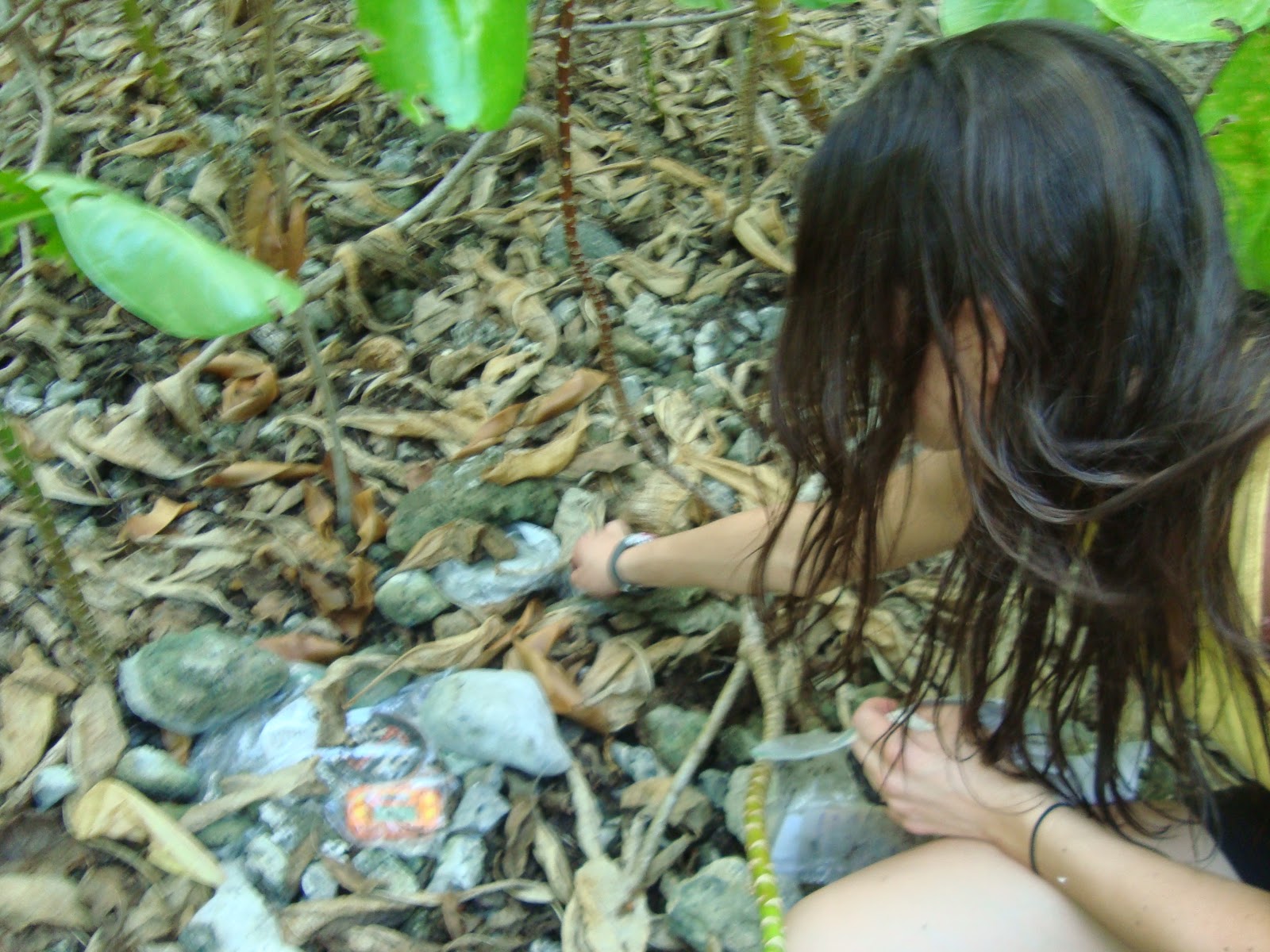
 We got it all out of the bags and dried out. The bags included these hilarious Winona Rider postcards, no idea where the guys found these. My bag had a DVD of a movie called "The Spanish Apartment". It seems like a great movie, but half way through my computer couldn't read the disc, so I'll have to finish watching this when I get back to the states.

Gavin also knows how much I hate the "Family Circus" comics that you see in newspapers everywhere. I think they are the lamest comic strip ever written. However, if you go back and read the ones from 70's they're actually not that bad.

Anyway, Gavin included this article about a petition to remove the Family Circus from a paper in St. Lious, which I find to be hilarious. Thanks for thinking of us Gavin!

Another interesting experience I had awhile back was to try something called Dragon Fruit. This weird looking fruit is native in North America, but I had never heard of it before. I ate some on the plane from Hong Kong to Singapore and really liked it, and then found out they had it here at the local grocery store. I find that it tastes a lot like a melon, maybe like honeydew, but also is somewhat citrusy. 


We got a wind surfing lesson the other day from some air fore guys even though we couldn't go out on the water. It looks like so much fun and I really hope we get to try it out before we leave. It also seems like it might be pretty difficult to learn when you first start out. 


Here's me messing around with one of the bigger sails. It was really hard to control! The other guys said they typically have to use a special harness when using the sails like this.


Our post-DYNAMO travel plans are looking a little unsure. There has been a lot of uncertainty for all the flights coming and going on the island throughout the whole DYNAMO project, however there seems to be more hangups than usual in flight plans. Our supervisor, Heather, was hoping to leave today but found out that she is not scheduled to fly out for another 5 days. There's no guarantee that she'll make it on that flight though, and if she doesn't make that one she'll have to wait until we're scheduled to leave on Dec. 15th.

Our current plans are to fly to Bali after we get to singapore. Our flights are non-refundable so if we miss them we might just be stuck in singapore. This will be really bad for Steph because she was planning on flying straight out of Bali to the US without a connection in Singapore. She is also leaving much earlier than me to go spend xmas with her family. I have more flexibility since I have to come back to Singapore to get my flight back to the states, but it would still be a bummer to miss out on Bali. I recently learned about a cheap ferry to Sumatra from Singapore that might be a good alternative destination. Our other idea is to take the train up to Kuala Lumpur. If you have suggestions of other places to see that aren't too far from Singapore please let me know!

Saturday, December 3, 2011

There she blows!

In the wake of the MJO there is a strong low-level flow blowing from west to east know as the "westerly wind burst" (WWB). Here on Diego Garcia it's pretty obvious that the WWB is upon us. I hung out with some windsurfers the other day who were itching to get out on the water because of how strong the wind was. Westerly wind is not ideal for windsurfing in the lagoon, but the conditions yesterday were good enough to get some decent windsurfing in anyway. However, due to a recent fishing boat accident that killed a couple people the officials haven't allowed anyone to go out fishing or windsurfing.

The upper-level wind above the WWB is usually in the opposite direction as the low-level wind. I took this time-lapse video this afternoon to try and show this. 


I was also looking at the data collected at the other DYNAMO sites and found this time-series plot from Gan, which is an island near the equator, north of Diego Garcia. 

Notice in early November that the upper-levels are relatively dry. If you blur your eyes you can see how the low-level moisture builds and becomes deeper leading up to the convective period in late November. This process is sometimes referred to as the "recharge-discharge" cycle. The buildup of moisture can be thought of as a build up of energy in the column, which is then "discharged" during the deep convective period or "wet-phase" of the MJO. You can also see the strong westerly wind in the lower-levels in late November.


I'm still a little tired from last night. Steph and I headed out to the famed "Brit Club" and played a little beer pong. We lost pretty badly twice in a row, but we didn't let the shame ruin our night.


We hear that there are some high level british officers on the island checking in on things, so the Brit Club was relatively tame, meaning none of the brits came dressed in drag or took their clothes off and drank a random mix of alcohol out of a rubber boot on top of the bar.

After some snorkeling yesterday we were walking back to the truck and came across a group of merchant marines having their weekly BBQ. They invited us to have some food and a few beers. They were really nice and interesting to talk to.


They were curious about why we were here on the island and had never heard of the MJO, so I whipped out my laptop and did my best to explain what it was.


Thursday, December 1, 2011

The Good Life

Stephanie's snorkel fail:


I'm in a great mood today! I found out this morning that we're going to only be doing 4 weather balloons a day from here on out! I'm pretty excited about this for a few reasons.
  1. I'll be able to get way more (and more regular) sleep
    • Having to stay till 4 am every other day was hard to cope with
  2. I'll be able to hang out at the bars when other people are there
    • Until now we've either worked until 10:30 or had to leave for our shift around 10:30, so every time there was an event we would either be tired from a shift or have to leave before it got going.
  3. We'll get more time off in between shifts to explore the island, snorkel, windsurf, go fishing, etc.
  4. I'll be able to focus on my research for a poster that I need to finish for a meeting in January.


We went snorkeling today and it turned out to be the best visibility we've had. We found some tugboat wreckage and I got some video of a sea turtle. I thought it was a rock at first until it started moving./ The visibility still wasn't that great, but I posted the video on Facebook if you're interested.
The end of this special observing period is happening mostly because we are limited on resources (i.e. helium), but we also captured the initiation of an MJO event, which is exactly what we came to do! The MJO is still very active (we're at the end of the blue line on the plot to the left), and we'll still be collecting data into January that will be very useful. The data we've collected so far is going to make for some great hind-cast experiments, as well as testing a cumulus cloud scheme that I'm developing. 

The wet phase of the MJO  was manifested here on DG as overcast skies and lots of light rain so there wasn't any opportunities to take any cloud pictures, but as the convective signal of the MJO moves over towards indonesia we should be seeing much clearer weather where we'll be able to see individual storms at a distance.


I really love coconut, and there's tons of them here just lying around! However, I need a machete to get at one, and the only people that have those are the filipinos. However, I was hungry and bored the other day and so I armed myself with the best tools I could find laying around and did my best to disassemble and devour an unsuspecting coconut. It took me about 45 minutes, but I was successful, and it was delicious! Here's some pictures to document the endeavor.

Best tools I could find for the job
The victim
Getting warmed up
I can see the light at the end of the tunnel!

The sweet nectar of victory
I could really use a spoon here
The aftermath. 

Coconut carnage! One coconut was SEVERELY harmed during the filming of this blog post.